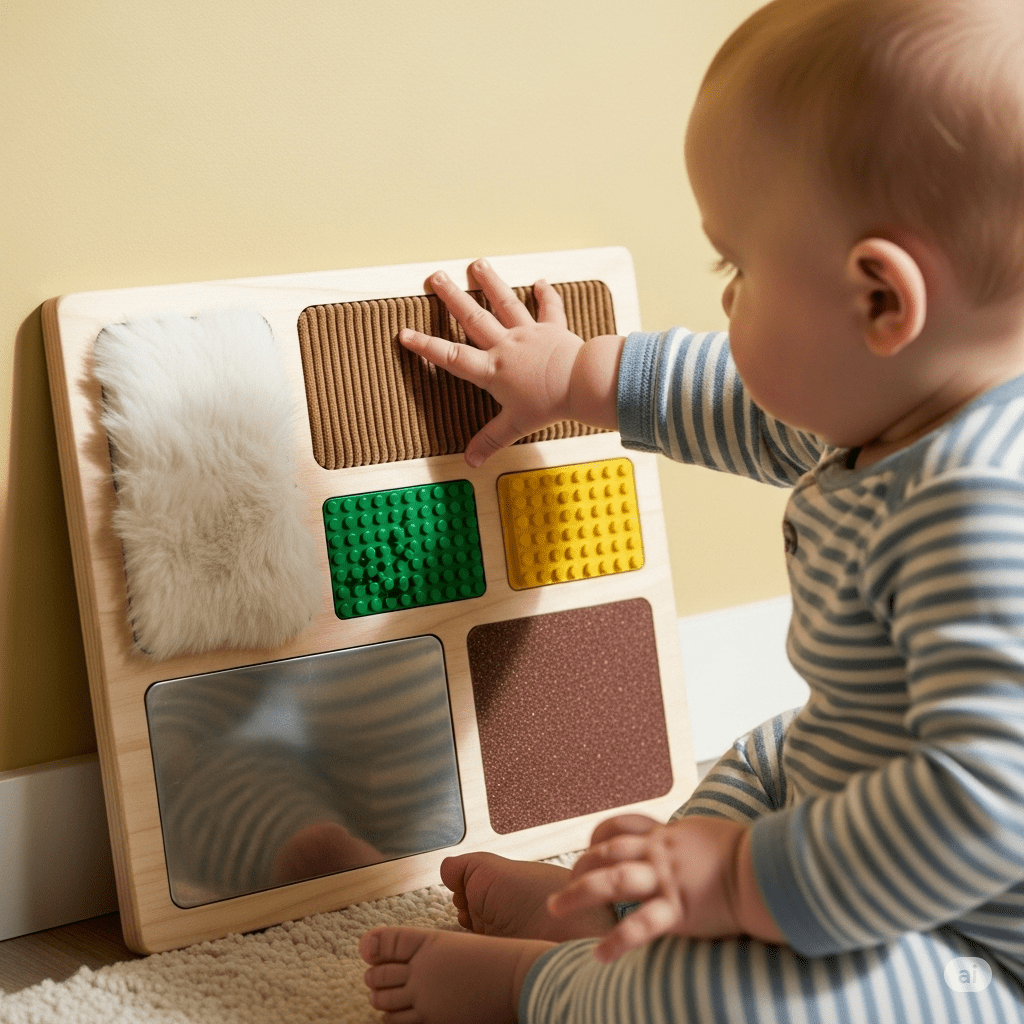
✋👶 Activity Name: Texture Board Exploration
Age: 0–1 years
Domain: Mind 🧠
Montessori Area: Sensorial (Tactile Discrimination)
Difficulty Level: Easy
Play Mode: Independent or Guided
🛠 Step-by-Step Guide (DIY or with store-bought options)
🧩 Setup (DIY at Home):
- Find a sturdy board Use a thick cardboard, old tray, or wooden board as the base (A4 size is perfect).
- Collect textures from around the home: Stick 6–8 different textures spaced apart on the board. Use:
- Felt
- Bubble wrap
- Cotton
- Sandpaper
- Velvet
- Plastic mesh
- Wool
- Aluminum foil
- Rice grains glued to paper
- Pieces of denim or towel fabric
- Attach textures securely Use non-toxic glue, double-sided tape, or Velcro so baby can feel without pulling them off. Avoid sharp edges.
- Present the board Place the baby in tummy time, lap position, or seated with back support. Let them explore the board freely with hands.
- Encourage gentle touch Demonstrate slowly. Let baby touch one texture at a time, or move their hand slowly if needed.
💡 Ideas for Maximum Impact
- 🗣 Name the textures: Say “soft,” “bumpy,” “rough,” etc., to build sensory-language link.
- 👩👦 Mirror baby’s response: Show delight when they explore – this reinforces attention.
- 🔁 Rotate textures weekly to maintain novelty.
- 🔄 Let baby explore same textures in different objects later (rough sponge, soft toy, etc.).
- 🧼 Clean the board weekly to keep it hygienic and safe for mouthing.
🔬 Science-Backed Benefits
- Tactile exploration is vital for the somatosensory cortex, which helps babies understand shape, size, and material—a base for object recognition and motor planning.
- Enhances neural mapping: Each texture strengthens sensory nerve development (Fields, 2005).
- Builds early discrimination skills—children begin noticing how things differ, a precursor to problem-solving.
- In Montessori, tactile play is foundational for later writing, geometry, and science work — it is a form of sensorial categorization.
- Infants who engage in tactile play show better emotional regulation (touch = calming stimulus) and body awareness.
🔆 Sun’s Growth Model Connection:
This activity sits in the “Observe & Orient” and early “Explore & Engage” stages of Mind 🧠 development.
It promotes:
- Sensory intelligence
- Curiosity and attention span
- Independent exploration
- Lays the foundation for mathematical and spatial reasoning
It’s more than just touching textures — it’s laying down brain pathways for noticing, comparing, and remembering.
🧠 Parent Tip / Challenge:
- After a few days, observe which textures your baby touches most. Are they drawn to soft or rough? Warm or cold? Use this info to personalize other play materials (like blankets, books, or rattles).
Supporting Tools and Toys
Visit Sun’s store for supporting tools and toys -> https://linktr.ee/sunsparadisemvm
 Sun's Paradise